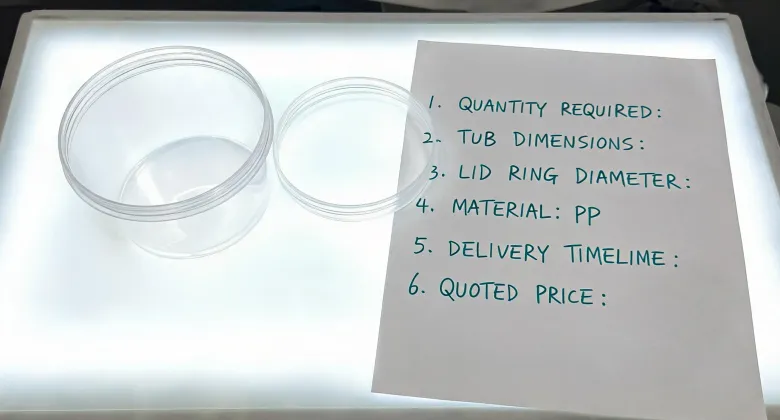
You know that feeling when a quote comes in noticeably lower than the rest, and you think you've just made a smart buying decision?
That was me in early 2019. I needed 30,000 five-liter plastic tubs with custom four-color printed lids for a regional food processing client. Four suppliers responded to my bulk plastic tubs inquiry. The lowest was 34% below the next lowest. I placed the order without much second thought.
The problem I thought I had: "I found a better deal."
The problem I actually had: "I'm comparing things that aren't comparable."
The tubs arrived. They looked fine on the line. Then the seal test flagged that roughly 15% of them were weeping at the lid seam. The 20,000 printed lids were offset about 3mm from center—not catastrophic, but outside what our client's quality team would accept.
Total damage: $4,200 in scrap, another $1,800 in contract penalties to the client, three weeks of delay, and a phone call I'd rather not relive.
I've been sourcing plastic packaging for eight years. I've personally made—and documented—six significant mistakes that have added up to roughly $18,000 in wasted budget. Now I maintain the checklist our team uses to keep other people from repeating them.
Let me walk through why this keeps happening to buyers—not from a "what to check" angle, but from a "why the quote comparison process is structurally broken" angle.
What's really behind those price gaps
1. The "supplier" you're comparing isn't always a factory
A lot of companies you find when searching for plastic tubs wholesale are traders. They source from a factory, add margin, and quote you. That's not shady—it's business. But when you're comparing quotes, you're essentially comparing a trader's markup against a factory's ex-works price and pretending they're the same thing.
Worse: traders don't hold the mold. If they switch factories—and they do, sometimes without telling you—your "custom plastic tubs" spec can drift. I've seen wall thickness vary by 0.4mm between two shipments of the same SKU because the trader changed subcontractors.
2. "Custom" means different things to different suppliers
When you ask for custom made plastic tubs, what exactly are you asking for? Custom size? Custom color? Custom printing? A brand-new mold? A custom lid or sealing method?
I've put four quotes side by side where one supplier's "custom" meant one-color printing, and another's included four-color printing plus a custom-molded handle. The unit price gap was 22%. The buyer picked the cheap one and didn't learn until later that it didn't include the $350-per-color plate setup fees—for three colors.
3. MOQ economics are stranger than they look
Bulk plastic tubs pricing isn't linear. A 20,000-piece run can be cheaper per unit than 50,000 if the supplier has minimum resin order requirements for your color or needs you to cover the mold.
The quote that says "$0.80 per unit for custom plastic tubs" often has a $2,500 mold fee and a 30,000-unit minimum attached—something the factory's own quote sheet may not lead with. In my experience: the quoted number rarely lies. It's what's not on the quote that costs you money.
4. "Food grade" is a marketing phrase, not a spec
This one took me a few years to appreciate properly, and it's a big pitfall. FDA 21 CFR 174–190 covers food-contact materials in the US. The EU has EU 10/2011 for plastics in contact with food. But if a supplier says "food-grade plastic" without being able to produce a compliance declaration for the specific resin grade and the specific application, that phrase means very little.
I've seen "food-grade" tubs get resold where the original resin supplier—the company that actually makes the polymer—never issued a food-contact statement for that application. Compliance documentation isn't about the plastic in general. It's about the specific material and use case.
5. Freight and landed cost often flatten the unit-price advantage
On a 50,000-piece order I worked on, I compared two suppliers: one was 12% cheaper per unit but shipped from a port five days farther out and required extra transshipment. The other was more expensive per unit but offered direct full-container loading. Once I built the landed cost—freight, port fees, inland transport, demurrage risk—the "cheaper" supplier was actually $0.04 more per unit.
This happens more often than anyone admits.
What this actually costs you
I want to be specific, because the hidden cost of a "cheap" quote rarely gets quantified honestly.
The 2019 mistake: $4,200 in direct scrap, about $1,800 in penalties to the client under the penalty clause, and three weeks of delay that nearly cost me the account. The client stayed for about 18 more months, but the trust was thinner. That part stung worst.
Something more insidious: we later found out the "trader" had never actually placed a formal mold order or held food-contact documentation. We'd paid for something that didn't legally belong to our supply chain.
On another order—44,000 custom-printed lids in 2022—I made a different but related mistake: I checked the primary print quality but not the edge compliance. About 12,000 lids had slight ink bleed between the print zone and the lid's sealing surface. The factory said it met their internal standard. The client's safety audit team disagreed. Reworking those 12,000 lids cost us about $2,600 and pushed the delivery back by a full week.
Here's the pattern I've come to accept after eight years in this industry: in plastic tubs sourcing, you're actually buying three different things—the plastic (resin), the process (molding), and the compliance (documentation). Most quotes price two of those three and leave the third as an unspoken assumption.
And when compliance slips, that's when the "cheap" quote stops looking cheap. For a food-contact product, one rejected pallet can set off a chain of events—client audits, product hold, brand damage—that costs multiples of whatever you saved on the unit price.
So what does a sane sourcing process look like?
I'm not going to pretend there's a magic fix. But since we changed our process in 2023, we've caught 11 potential spec mismatches in 14 months—each one of them was a four-digit problem waiting to happen.
Ask suppliers to break the spec apart
Don't just ask for a quote on "5L tubs." Ask for: resin type (PP vs PE, and the specific grade), wall thickness (with a measurement location), lid sealing method (friction, screw, gasket), printing method (pad print, screen print, IML) and number of colors, and what compliance documentation will accompany each lot.
If a supplier responds with "that's all standard for our tubs," that's a red flag.
Get a paid sample before you get a cheap quote
A $200 sample is cheap insurance against a $30,000 order. Test the seal. Test the print alignment. Test the actual opening mechanism with your hands. Use hot water, oil, or whatever your client will put in it.
Calculate total landed cost, not unit price
That means freight, mold amortization, plate fees, scrap rate (assume 1–3% damage unless you have data), delay costs, and compliance documentation gaps.
Ask the "factory or trader" question—but get evidence
This one's actually not hard, but it's hard to do without being obvious about it. Ask for their factory registration, factory address, a video of the production floor, or a recent audit (SMETA, ISO 9001). If they hesitate, you have your answer.
I'd rather spend ten minutes explaining to a client why we're asking these questions than deal with a mismatched order six weeks from now. An informed buyer asks better questions and makes faster decisions.
One last thought
The single most useful insight I've gained from eight years of plastic tubs sourcing is this: a cheap quote is rarely cheap on purpose. It's cheap because you're comparing something that isn't the same thing you're buying.
The "cheaper means saving money" thinking comes from a time when price lists were actually comparable one-to-one. Now most businesses are comparing different specifications, different compliance levels, and different trader-to-factory relationships. The numbers are real. But the comparison isn't.
If you want to do this well, slow down and figure out what's actually in the quote before you worry about the price at the bottom. That ten minutes of extra work is the cheapest part of the whole order.
A note on compliance references: US food-contact material regulations appear in 21 CFR 174–190. EU requirements for plastics in contact with food are set out in EU 10/2011. Suppliers should be able to provide a statement of compliance tied to the specific material and application—not a generic "food-grade" note.